Sep 22, 2026
OCPP EV Charger Compatibility Checks Before Ordering
A testable checklist for verifying an OCPP charger against your backend before you commit to a bulk order — registration, sessions, power limits and recovery.
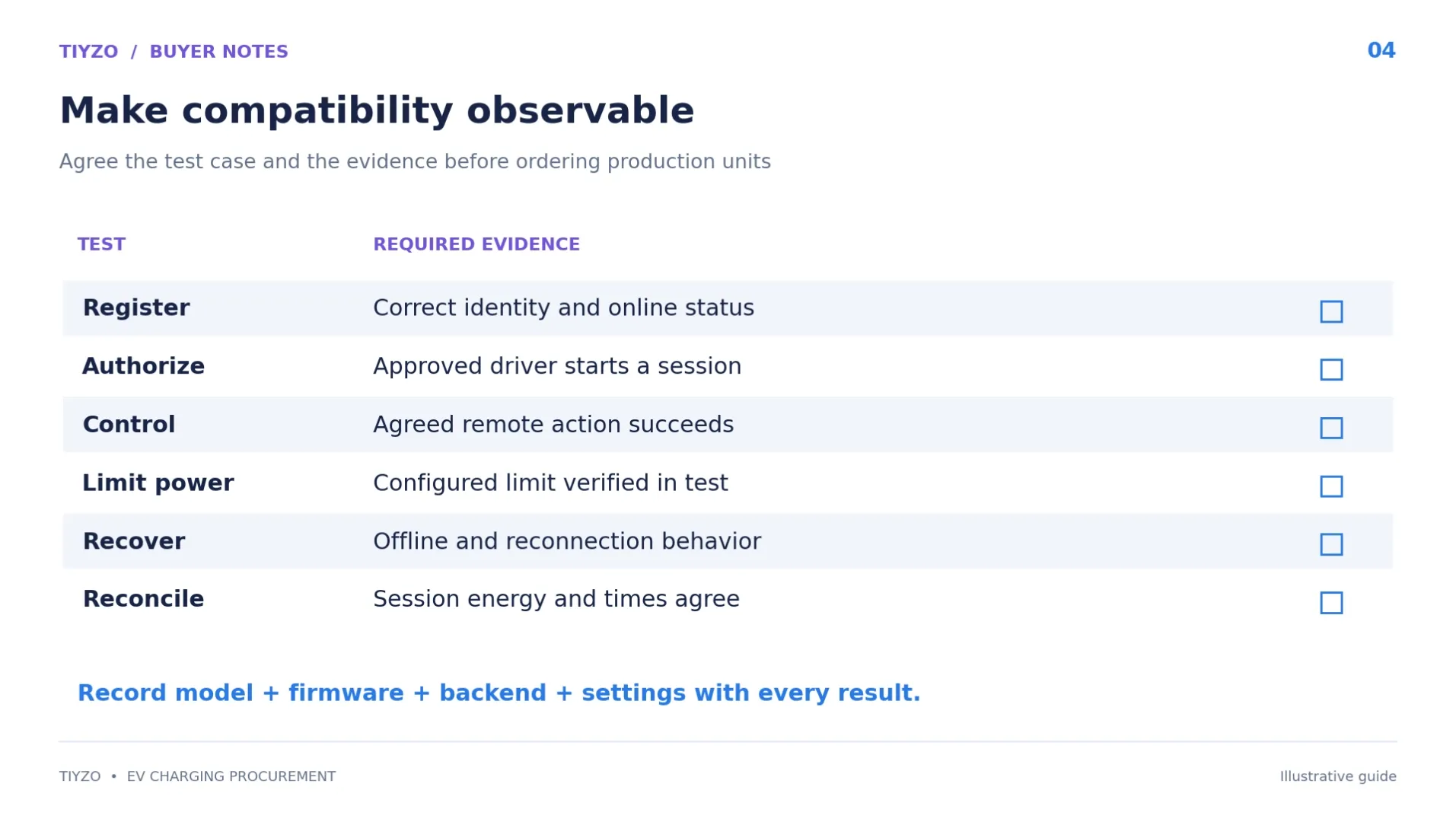
Suggested procurement test matrix. Agree pass criteria with the charger supplier and backend provider before testing.
Before ordering an OCPP EV charger, verify the exact charger model, firmware and charging management system together. “OCPP supported” is a starting point for evaluation. Your purchase decision should depend on whether the required operating tasks work on the configuration you will deploy.
OCPP defines communication between a charging station and its charging management system. The Open Charge Alliance also states that OCPP 1.6 and OCPP 2.0.1 are not compatible protocol versions. A backend may support both, but that capability needs to be confirmed. Open Charge Alliance protocol overview
Write a testable compatibility request
Replace “Does it work with our platform?” with a short specification naming the backend, OCPP version, charger model and mandatory workflows. Give both vendors the same document. Record who will configure the sample and who will investigate a failure, so integration does not become a dispute between suppliers.
Distinguish implementation from certification
Ask whether the offered product has an OCPP certificate, which version and test scope it covers, and how the supplied software relates to the tested product. The Open Charge Alliance runs a formal certification program and publishes certified products. Use those records to check a certificate claim; an OCA membership claim is not a substitute for a product certificate. Open Charge Alliance certification program, certified products
Certification does not replace your project-specific acceptance plan. A property operator may need resident billing, while a fleet may prioritize controlled charging windows. Translate each requirement into an observable test and ask for a result on the proposed backend.
Workflow: Registration — Evidence to capture: Correct station identity and connection status in the backend
Workflow: Authorized session — Evidence to capture: Approved user starts and ends a session; identifiers remain consistent
Workflow: Remote operation — Evidence to capture: Requested commands produce the agreed device response
Workflow: Power limit — Evidence to capture: Measured or logged behavior matches the agreed limit test
Workflow: Connection recovery — Evidence to capture: Documented offline behavior and recovery after reconnection
Workflow: Session records — Evidence to capture: Times, energy units and transaction records reconcile as agreed
Test failures as well as normal sessions
Include a planned loss of connectivity under controlled test conditions. Agree in advance whether a new session may start offline, whether an existing one continues and how records are reconciled afterward. The useful outcome is documented behavior matching the operator’s requirements, not a generic promise that the charger “works offline.”
On a two-port product, check that the backend identifies each active session correctly. Stop one session and observe the other. Repeat the agreed power-allocation test with both ports active. Save timestamps, configuration settings and relevant logs so that the result can be reproduced.
Ask how site power is measured and controlled
OCPP 1.6 includes smart-charging support, but that alone does not specify a complete building load-management installation. Open Charge Alliance protocol overview
Ask the project designer where available capacity is measured, which controller makes decisions and what limits apply if communications fail. Then include those agreed behaviors in the test plan.
Keep the approved configuration traceable
Name the hardware version, firmware build, backend environment and settings in the acceptance record. If firmware changes before shipment, ask which tests must be repeated. For a pilot, retain an approved sample or a complete configuration record that production units can be checked against.
Before handover, agree who controls backend credentials, who can change the connection endpoint and how a future platform migration would be handled. The customer should understand both the technical steps and any commercial dependencies before signing the order.
Questions buyers often ask
Does OCPP guarantee compatibility with every backend?
Do not use it as a blanket guarantee. Confirm the protocol version, product scope and actual workflows on the intended platform.
Does OCPP support prove Plug and Charge will work?
No. Treat that as a separate end-to-end requirement and ask vendors to identify the vehicle, charger and backend capabilities they have actually tested.
What should the final test report contain?
Include the equipment and software versions, test setup, pass criteria, results, unresolved issues and the parties responsible for corrections. A successful connection screenshot alone does not document the rest of the operating workflow.
Discuss your backend requirements with Tiyzo
Send us your backend name, required OCPP version, target charger configuration and essential functions. We can review the available product information and discuss the testing needed before you commit to a bulk order. Compatibility statements should remain specific to the configuration and evidence available.
Related reading
-