Sep 25, 2026
Private Label EV Chargers for Distributors
An approval framework for launching a private-label EV charger range — product, branding, software, documentation and service across sample, pilot and production.
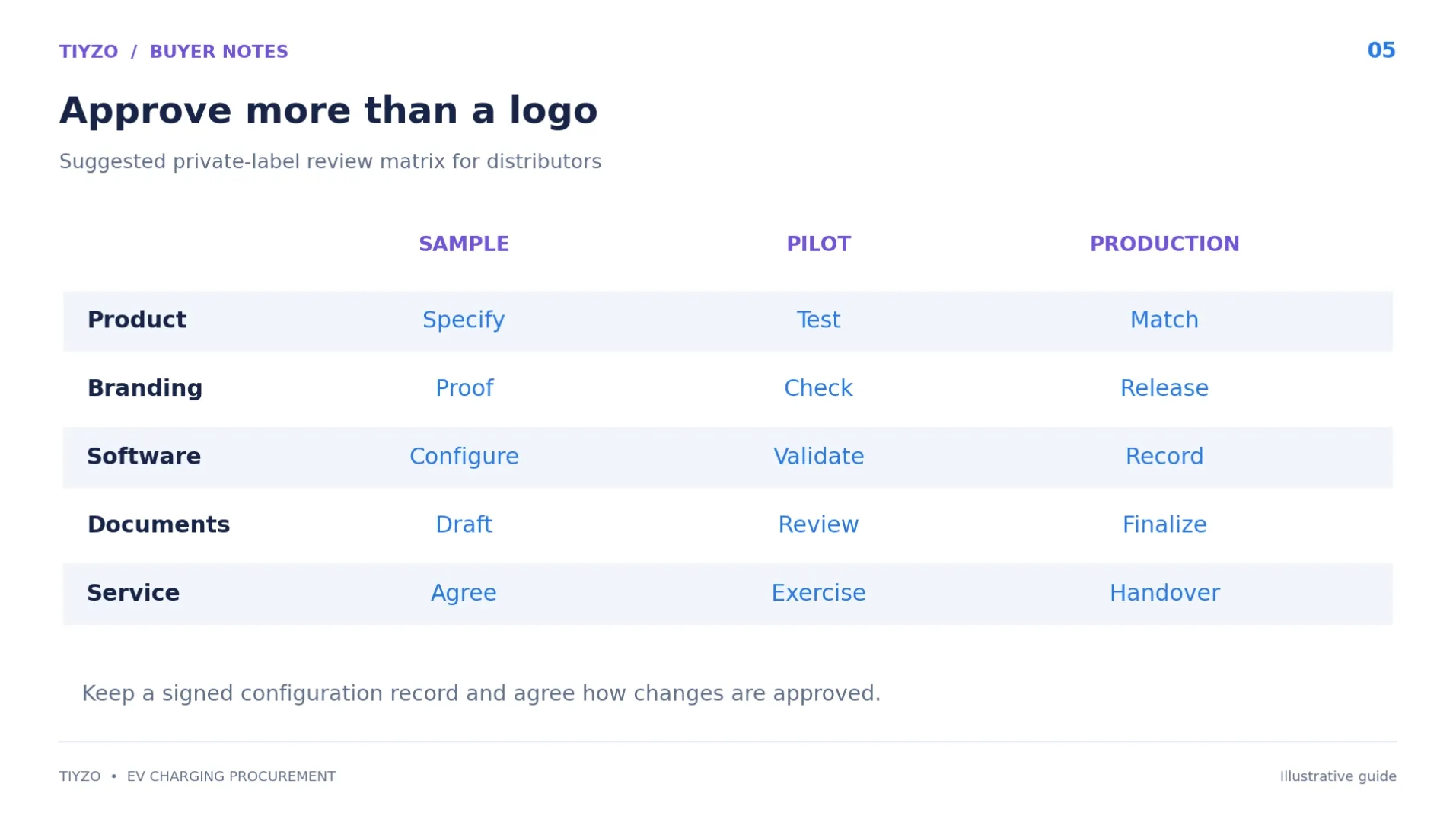
A suggested approval framework for a private-label program. Each stage needs its own documented acceptance criteria.
A private-label EV charger program needs a defined product, a documented approval process and a workable service arrangement. Adding your logo is one part of the project. Your customers will also expect consistent operation, clear installation documents and support when equipment needs attention.
For a distributor launching a first range, begin with a specific buyer and installation scenario. An installer supplying workplace projects needs a different offer from a retailer selling home chargers. Choose the first model around that use case, then agree what must remain consistent from the sample to the production order.
Define the first SKU narrowly
Write one line identifying the target market, current rating, connector, cable length, mounting arrangement and operating method. A narrow starting specification makes sample approval more meaningful. It also prevents several similar configurations from being mixed under one sales description.
Separate branding from product development
Ask the supplier to distinguish existing options from engineering changes. Logo placement, packaging artwork and a different cable assembly are not the same kind of work. Request a written description of the proposed change, any additional validation, and what happens to the schedule if the design changes after sample approval.
Workstream: Hardware — What to agree before ordering: Model configuration, approved sample and allowed component changes
Workstream: Branding — What to agree before ordering: Artwork, logo locations, packaging files and approval responsibility
Workstream: Software — What to agree before ordering: App or backend scope, account ownership and recurring charges
Workstream: Documentation — What to agree before ordering: Installation guide, labels, traceability and destination-market evidence
Workstream: Service — What to agree before ordering: Diagnostics, replacement parts, return process and cost allocation
Check the documents for the product you will sell
Ask how your brand and model designation will be represented in the applicable compliance records and product labels. For an ETL-listed configuration, verify the relevant listing details and agree any required private-label arrangements with the supplier and certification body. A certificate for another configuration should not be treated as proof for your branded unit, so ask Tiyzo which listing applies to your branded SKU. Intertek ETL Listed Mark
Request the installation manual, user instructions, packaging labels and serial-number format during sample approval. Check that the model names agree across documents. This is easier to correct before stock is distributed to installers in several locations.
Turn the sample into an approval record
Evaluate the functions your customers will actually use. For an installer-focused commercial model, that might include access control, session records and the agreed backend workflow. For a residential model, it might include commissioning and scheduled charging. Record the test setup and pass criteria rather than relying on a short video.
Photograph the approved label, cable, connector, mounting parts and packaging. Record the firmware and retain the approved artwork revision. If an item changes before production, ask the supplier to explain the impact and obtain your approval. This gives both parties a practical reference when inspecting the shipment.
Price the offer as a distributor
Build your margin calculation using the equipment quote, accessories, freight, destination charges, any applicable duties or taxes, software and a service allowance. Keep assumptions visible. Ask whether spare parts, replacement freight or local repair labor are included, excluded or handled case by case.
Agree who handles the first customer problem
Write a simple support scenario into the commercial discussion. If an installer reports a charger that will not connect, who collects the logs? Who diagnoses it? Who authorizes a replacement, and who pays for each shipment? Clear responsibilities help a distributor quote support honestly to its own customers.
Start with a pilot size that both sides agree is useful. Define what must be learned before the next order: installation feedback, operation on the selected platform and the service process. Avoid adding several untested variants simply to make the first catalog look larger.
Questions distributors often ask
What is the usual minimum order quantity?
There is no single quantity to assume for your program. Request the minimum for each configuration and customization scope, including whether packaging or accessories create separate minimums.
Does OEM include a branded app?
Only if the agreement says so. Define app branding, account control, hosting, updates and recurring fees separately from hardware branding.
Can a distributor obtain exclusivity?
Discuss territory, product scope, sales channels, commitments and duration explicitly. Do not assume that private labeling provides exclusive sales rights.
Discuss your first branded charger with Tiyzo
Send us your target country, customer type, proposed first-order quantity and preferred configuration. Tell us whether you need hardware branding, packaging changes or a backend discussion. We can review the available options and identify what needs confirmation before a sample program is agreed.
Related reading
-