Sep 19, 2026
48A vs 80A EV Chargers for Commercial Sites
Nominal AC power at 208V and 240V, vehicle limits and parking windows — how to decide whether a 48A or 80A commercial charger fits your site.
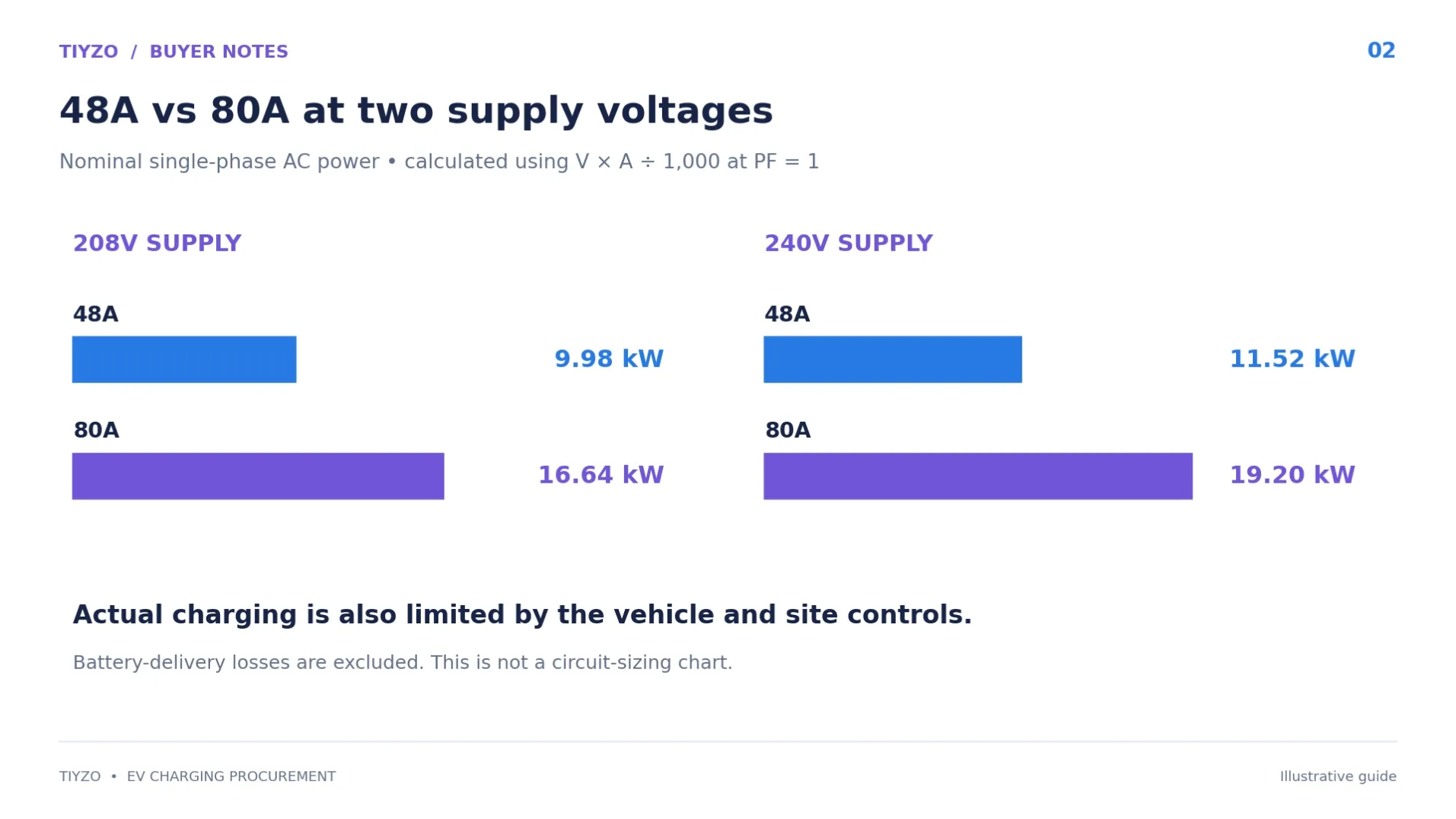
Calculated nominal single-phase AC power at power factor 1. These are not measured charging rates or battery-delivery guarantees.
Choose an 80A EV charger when the vehicle can accept the additional AC power, the site can supply it and the shorter charging window has practical value. A 48A unit may already meet the daily requirement at a workplace or overnight parking site. Start with those conditions before paying for a higher rating.
The amp rating is only part of the comparison. Commercial AC chargers are rated per port, so the supply and the vehicle both matter. Supply voltage changes the nominal power available at the same current. Vehicle limits and any site control settings can reduce the rate further. The DOE describes AC Level 2 equipment as using 208V or 240V supply in the United States. DOE AFDC charging equipment overview
Read the power calculation correctly
For the simplified single-phase comparison shown above, nominal power in kW equals voltage multiplied by current and divided by 1,000, assuming a power factor of 1. Battery energy delivered will also depend on conversion losses and vehicle operation. Do not use the chart as a wiring or circuit-sizing instruction.
Check the vehicle before comparing the charger
A vehicle with an 11 kW maximum AC charging rate cannot take 19.2 kW simply because it is connected to an 80A station. In that example, the vehicle remains the limiting factor. Obtain the AC charging specification for the exact vehicle version, especially when purchasing for a fleet with known models.
Avoid using a vehicle’s DC fast-charging figure as its AC acceptance limit. These describe different charging paths. The charger quotation should identify the application clearly enough that the fleet manager can compare like with like. DOE AFDC charging equipment overview
Use the available parking window
Suppose a vehicle needs 40 kWh of additional battery energy. At a constant 11.52 kW, dividing energy by power gives 3.47 hours. At a constant 19.20 kW, it gives 2.08 hours. These are ideal calculations excluding losses and charging-rate changes, not promised completion times. The higher figure helps only if the vehicle and supply permit it.
If the vehicle is parked for eight hours, both configurations might have ample time under those assumptions. If it returns between shifts and has a narrow turnaround window, the additional AC capacity may justify closer evaluation. Record actual daily energy needs rather than assuming every vehicle arrives empty.
Project question: Vehicle AC limit — When 48A may fit: Vehicle cannot use much more than the 48A supply offers — When to evaluate 80A: Vehicle can accept meaningfully more AC power
Project question: Parking time — When 48A may fit: Daily energy fits within a longer stay — When to evaluate 80A: Short turnaround makes added power useful
Project question: Site allocation — When 48A may fit: Per-port capacity is limited — When to evaluate 80A: Additional capacity is available and justified
Project question: Future vehicles — When 48A may fit: No confirmed need for higher AC power — When to evaluate 80A: Planned vehicles support higher AC input
Account for simultaneous charging
Specify the number of vehicles charging together and the power the site can allocate to them. Buying 80A hardware for every bay does not establish that every bay will run at 80A. Ask for the proposed current limits at full occupancy and how those limits change as vehicles arrive or leave.
Ask for two quotations with the same scope
Compare a 48A design and an 80A design using identical assumptions about port count, backend, cable length, mounting and service. Ask the installer to show any difference in electrical work separately. This helps you decide whether additional output buys a useful improvement for your particular operation.
For a future expansion, request the cost of preparing the site now as well as the cost of adding equipment later. Document whether any current limit is a temporary commissioning setting or a permanent constraint of the installation.
Questions buyers often ask
Is an 80A charger always faster than a 48A charger?
No. It offers a higher current ceiling, but the actual rate may be limited by the vehicle, supply or site controls. Compare the expected operating rate for your vehicles.
Does 48A always mean 11.5 kW?
No. At nominal 240V, the simplified calculation gives 11.52 kW. At nominal 208V, it gives 9.984 kW. Check the actual product rating and supply.
Can I choose a breaker from this article?
No. The calculations compare nominal charging power only. The installer must size the installation using the equipment instructions and applicable requirements.
Compare options for your vehicles
Send Tiyzo the vehicle models, supply voltage, number of simultaneous sessions and typical parking time. We can discuss whether a 48A or 80A commercial AC option deserves a place on your shortlist, with the exact configuration confirmed before ordering.
Related reading
-