Sep 16, 2026
How to Choose a Commercial Level 2 EV Charger
A procurement framework for comparing commercial Level 2 chargers against the same project brief — demand, electrical fit, operation, service and expansion.
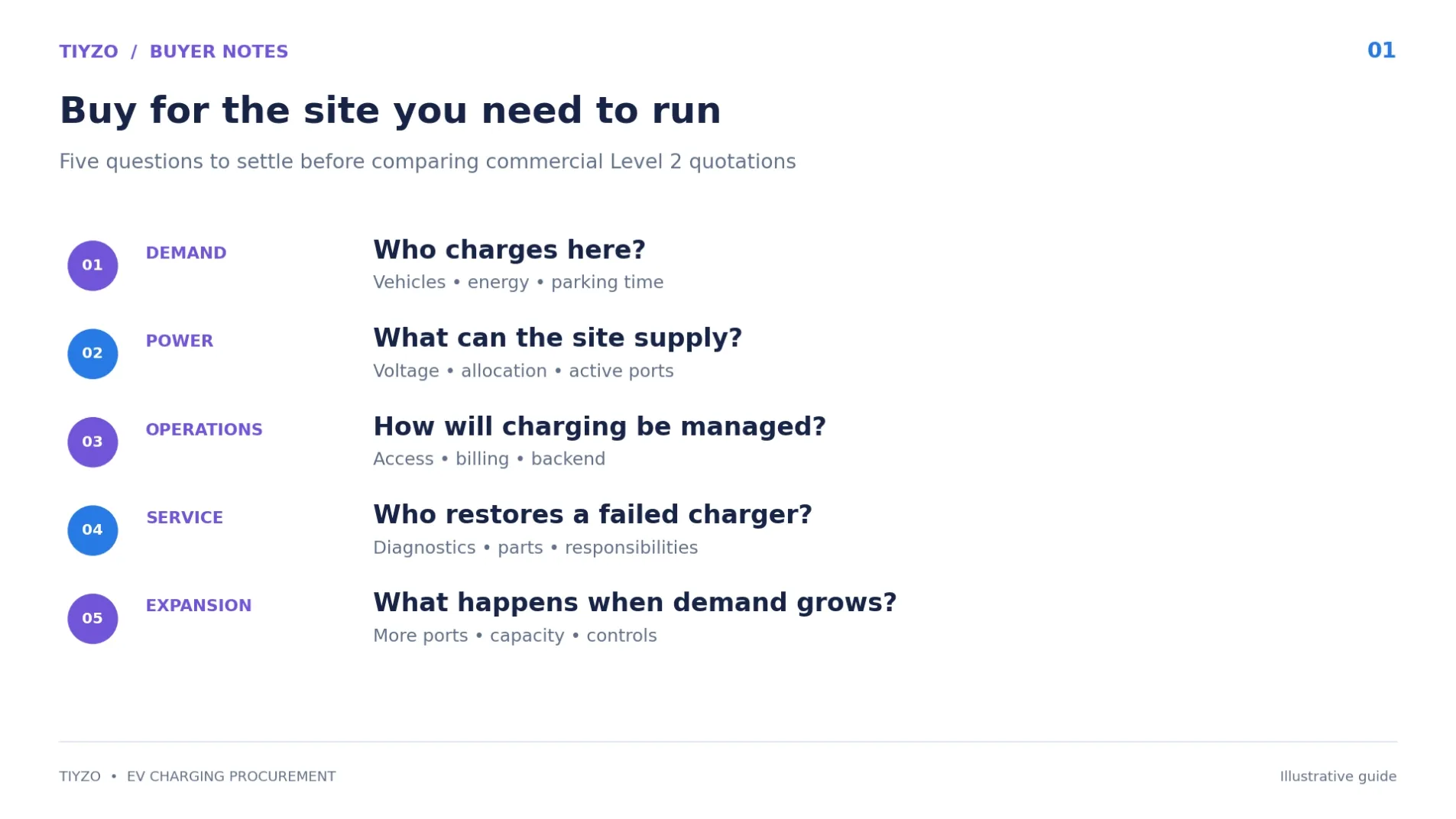
A procurement framework for comparing chargers against the same project brief.
A commercial Level 2 EV charger should fit the vehicles, parking routine and electrical capacity at your site. A higher current rating alone does not make it a better purchase. For an installer or property owner, the useful question is whether the proposed system will deliver the energy drivers need and remain manageable after handover.
Before requesting prices, write a short project brief. Include the location, initial number of charging spaces, typical parking time, expected vehicles and who will operate the chargers. This makes quotations easier to compare and helps suppliers identify missing requirements before equipment is ordered.
Start with the charging service you want to offer
An office offering employee charging has different operating needs from an apartment building assigning costs to residents. Decide who can plug in, whether charging is paid or free, and who handles a failed session. The DOE planning checklist likewise asks buyers to establish charging needs and networking requirements early. DOE AFDC charging infrastructure procurement
Compare proposals against a written brief
Ask each bidder to complete the same comparison sheet. Commercial AC chargers are one starting point; the brief is what makes quotes comparable. A quotation that says only “commercial charger with app” leaves too much open. Name the required operating tasks and ask the supplier to demonstrate them on the offered hardware and software.
Decision: Charging demand — What to request: Expected vehicles, parking duration and energy needed per visit
Decision: Electrical fit — What to request: Supported input voltage and phase, adjustable current and installation instructions
Decision: Daily operation — What to request: Driver access, billing method, reporting and operator permissions
Decision: Service — What to request: Fault diagnosis process, replacement parts and warranty responsibilities
Decision: Expansion — What to request: How more ports will be added and controlled within the site budget
Separate charger capacity from site capacity
Have the electrical contractor confirm the supply and the capacity allocated to charging. Give that information to the supplier with the number of ports. Request a description of what happens when several vehicles arrive together, including any current reduction or charging queue.
Consider an illustrative office where ten vehicles each require 12 kWh during a six-hour stay. That is 120 kWh of battery energy, or 20 kW on average before losses. It is a starting point for discussion, not an electrical design: arrival times, losses, vehicle limits and operating reserve still matter. The exercise shows why both daily energy and simultaneous demand belong in the brief.
Check the exact configuration being supplied
Record the model, connector, cable length, enclosure, communications option and firmware version in the order. For an ETL-listed product, check the listing and its applicable scope rather than relying on a logo in a catalog. Intertek describes the ETL mark as evidence of conformity to applicable North American safety standards, and listing scope is model-specific. Intertek ETL Listed Mark Ask Tiyzo for the certification documents that apply to the exact configuration you are considering.
Make installation details visible before purchase. Ask for mounting drawings, cable-management options and the space required for service access. A compact enclosure may still be inconvenient if the cable cannot reach the intended parking positions.
Plan the handover before placing the order
Write down who creates the operator account, commissions the chargers and trains the site team. Ask who receives an offline alert and who can export session records. If the project uses a third-party backend, include a compatibility test rather than leaving integration until the installation date.
Compare the purchase over a consistent period, such as five years, using your own assumptions. Include equipment, mounting accessories, software subscriptions, connectivity and service arrangements. Keep installation and electricity estimates separate so that a low hardware price does not hide a different scope.
Questions buyers often ask
Does a commercial charger always need a payment terminal?
Define the users and payment method first. A private employee site and a public paid site may need different arrangements. Confirm the relevant payment and metering requirements for the actual location.
Should every parking space receive a charger immediately?
Compare an initial installation with a staged expansion plan. Ask the designer what work can sensibly be prepared now and what can wait until demand is demonstrated.
Can one product be used across the United States and Canada?
Ask for written confirmation for the exact configuration and destination. Do not treat suitability in one market as automatic approval in another.
Get a shortlist for your project
Send Tiyzo your project country, available supply, number of charging spaces and preferred operating method. We can discuss suitable commercial AC options and the documents you need to compare them. You can start with the information already available; list anything the electrician still needs to confirm.
Related reading
-