Sep 19, 2026
Dual Port vs Two Single Port EV Chargers
Two connectors do not tell you the current available at each port. How to compare a dual-port station with two single-port units on the same simultaneous output.
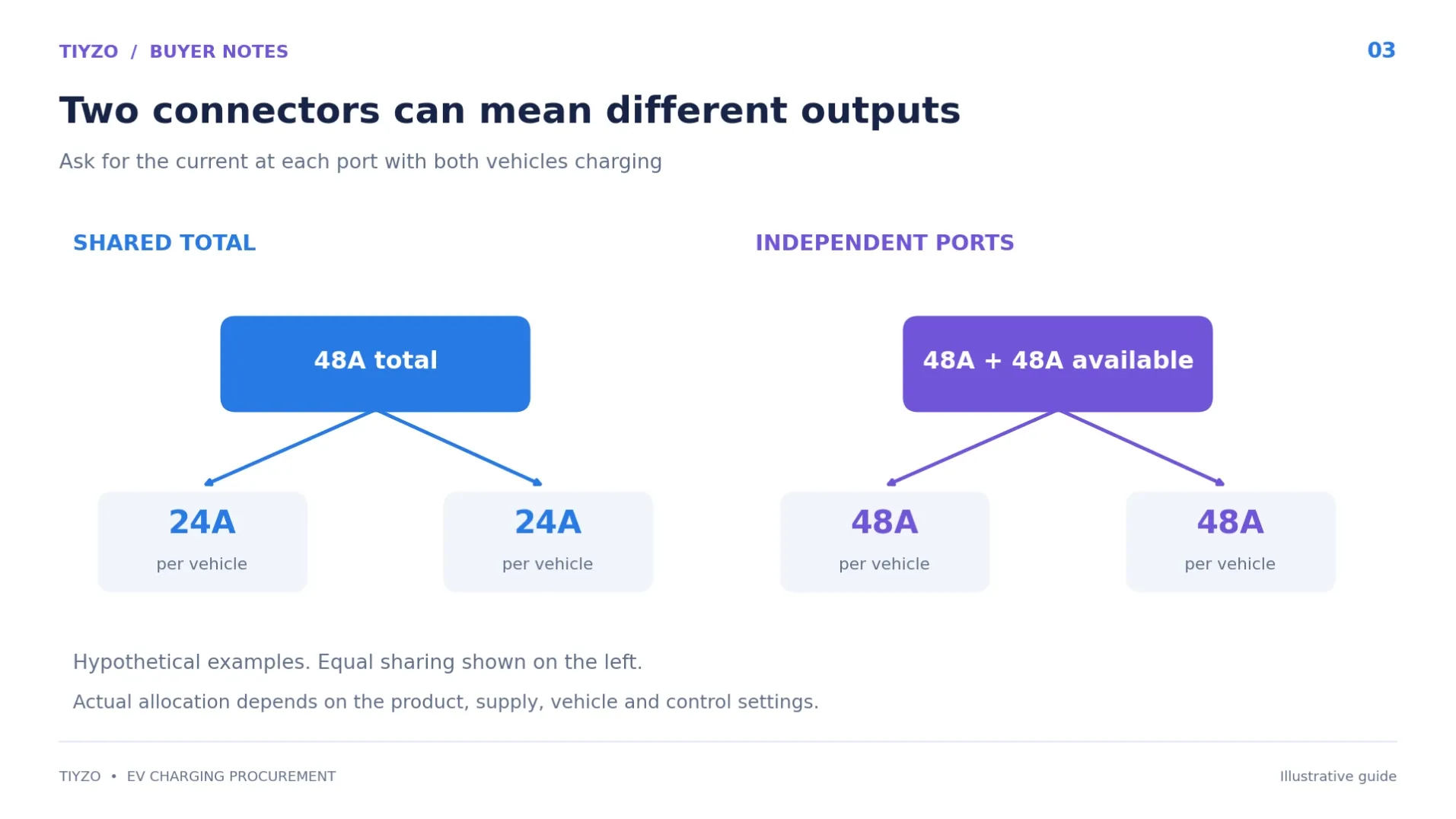
Illustrative architectures only. Two connectors do not identify the simultaneous current available at each port.
A dual-port EV charger can serve two nearby parking spaces, but it should be compared with two single-port chargers at the same simultaneous output. This article covers how to run that comparison; for the case for dual-port on commercial parking sites, see why dual-port 48A chargers suit commercial parking. The number of cables does not tell you how much power each vehicle receives when both are connected.
Start by asking the supplier for two operating cases. Dual-port AC chargers are one family to compare on that basis.: one vehicle charging, and two vehicles charging together. Record the current available at each port, the input configuration and any shared limit. Only then compare equipment price, installation work and maintenance.
Clarify what dual port means
The diagram uses two hypothetical designs. One shares a total of 48A equally between two active vehicles; the other allows 48A at each port when the necessary supply and equipment configuration are available. Both have two connectors. Their charging service is different, and neither diagram represents a specific Tiyzo model.
Put simultaneous output in the quotation
Avoid accepting “up to 48A” without stating whether the figure applies to the entire station or to each active port. Ask how the equipment allocates capacity when vehicles have different AC limits. A supplier should also explain what happens when one session stops and another continues.
Commercial manufacturers offer different physical configurations and power ratings. For example, ChargePoint describes the CT4000 family as offering single- and dual-port configurations with output specified per port. That is a useful example of the detail to look for, not a performance comparison with Tiyzo. ChargePoint CT4000 configuration example
Item to compare: Simultaneous output — One dual-port station: Confirm per-port and station-wide limits — Two single-port stations: Confirm each unit and any shared site limit
Item to compare: Parking arrangement — One dual-port station: Check reach from a common mounting position — Two single-port stations: Check reach from two separate positions
Item to compare: Electrical work — One dual-port station: Request the exact input and circuit arrangement — Two single-port stations: Price both units within the same site design
Item to compare: Service interruption — One dual-port station: Ask which faults can affect both ports — Two single-port stations: Ask what infrastructure remains shared
Item to compare: Commercial scope — One dual-port station: Confirm software and service fees per port or station — Two single-port stations: Confirm fees for both units
Draw the parking layout before selecting the enclosure
Mark the intended vehicle positions and charging-inlet locations on a simple site plan. Show pedestrian routes, protective barriers and where cables will rest. Ask whether the supplied cable-management arrangement works for both spaces without crossing the intended walking route.
Two individual units may suit spaces separated by a wall or driveway. A shared mounting position may suit adjacent bays. Treat these as layout options to test on the actual site, rather than assuming that either arrangement always saves space.
Compare the complete installed scope
Request separate prices for equipment, mounting, cable management, electrical work and software. A single enclosure does not by itself prove that only one supply circuit is needed. Two units do not automatically mean two entirely separate installations. The selected equipment and site design determine the scope.
If budget is tight, ask both bidders to price the same two-vehicle service requirement. Comparing a shared lower-output station with two full-output stations without noting the difference can make the cheaper option appear more attractive than it is.
Review service and expansion together
Ask which components are shared between the ports and whether a fault can disable both. Two separate chargers may still share a feeder, controller or network connection, so separation does not guarantee independent availability. Ask the supplier to describe a realistic repair process and the parts needed to restore service.
For expansion, show the next group of spaces on the same plan. Request an explanation of how the new ports will be managed alongside the first installation. This prevents an attractive two-space arrangement from becoming awkward when the parking area grows.
Questions buyers often ask
Can two connectors charge two cars at full speed?
Only if the product configuration, electrical supply, vehicle acceptance and control settings allow the stated output at the same time. Request a demonstration of the required two-car operating case.
Is a dual-port charger always cheaper?
Compare the complete installed and operating scope. Enclosure count alone is not enough to answer that question.
What should be included in an acceptance test?
For this comparison, request separate session identification, simultaneous charging, stopping one session while the other continues, and verification of the agreed limits.
Request a comparison for your parking layout
Send Tiyzo a parking sketch, the required output per vehicle, supply details and preferred connector types. We can help compare dual-port and separate-unit options on a consistent basis and identify the configuration details that need confirmation.
Related reading
-